Sunday, July 7, 2013

Birds of Spain!


When Anna said she wanted to move to Germany for a post-doc, I agreed on one condition:  that we take at least one trip to Spain (where I could speak the language) with the principle aim of finding birds.  The original pitch was a long weekend, which got extended into a week, on the grounds that Anna would rather spend a week with some non-birding time than a few days of non-stop birding.

The trip was AWESOME!  Since this is Anna’s blog, I will categorize the birds according to the Anna taxonomy (well, since Anna is the final arbiter of the Anna taxonomy, and like most taxonomic systems it changes frequently, this is categorized according to my best understanding of the Anna taxonomy):

Large Raptors:  Spain was really good for large raptors.  Highlights were large numbers of Griffon Vultures, the Spanish Imperial Eagle, and large numbers of what I think were mostly European Honey Buzzards, but feel free to correct me if there are other raptors mixed in!
Griffon Vulture, as seen from the castle on the top of the hill at Montfragüe

Griffon Vultures seen from Salto de Gitano.
My wife, watching a Griffon Vulture
Spanish Imperial Eagle!!! Many thanks to the birders who pointed this one out to us!  Note the diagnostic white on the leading edge of the wing (unless that means it's a California Condor...)

A kettle of raptors.  Kettle is the term used for aggregations of raptors all using the same thermal.  A thermal is an area of rising warm air, where the raptors can gain elevation with relatively low effort, then coast until they reach the next thermal.  I think they're mostly Honey Buzzards, but my raptor silhouette ID skills aren't that great, and I failed spectacularly at finding other birders to help me identify them.  I'm pretty sure the bird in the middle of the group right of center is not a Honey Buzzard.


Close up view of what I am pretty sure is not a Honey Buzzard.
This one I'm pretty sure is a Honey Buzzard.  If not, let me know, so I can take it off my life list...
Booted Eagle - we saw a few of these too - very reminiscent of Swainson's Hawk!

Colorful Birds:  Hoopoe was Anna’s favorite bird of the trip.  We were worried that we would not see one, as they were taunting us from a distance, with their distinctive song (not my video, but there is a link where you can hear the song here: http://vimeo.com/856613 ).  But finally, we got nice views of one in the morning as we were leaving El Rocio.

The Bee-eaters, Blue Rock Thrush, Rollers, Azure-winged Magpies, and apparently Purple Swamphens, also fit into this category (my Roller & Azure-winged magpie pictures are less than amazing, and I didn't get any pictures of the Purple Swamphen, so you'll have to Google them to see what they look like)

"Hoo-poo-poo"


"Yum, bees!"
Okay, so bee-eaters don't actually say "Yum, bees".  I actually don't know their call very well. 

Blue Rock Thrush: aptly named because it's blue and on rocks.

Flamingos: Not sure if this is a sub-group of the Colorful Birds, or a taxonomic group in its own right (actually the real taxonomic experts can't decide whether Flamingos are their own order, Phoenicopteriformes, or whether they belong as a family in a different order).  We saw several flocks of flamingos, and had one close and obliging individual.


 Little Brown Birds:  For some reason, I have not succeeded in convincing my wife that little brown birds are exciting.  I try and try, but have not had much luck.  This is tough, when one is a grassland biologist, where most of the species are little and brown.  But Spain has a nice assortment of sparrows, larks and warblers, many of which were new for me.

Okay, Anna did have to admit that this Reed Warbler was pretty cute.

Thekla Lark - larks were everywhere, but many of the species are similar, and I had a tough time identifying them!

Shorebirds:  We really struck out on shore-birds, but did see a few.  Sadly, my best views of the Kentish Plover were looking at this photo afterwards, as it was really back-lit.   Note that as a compromise in a long-standing discussion on how to pronounce the word "plover", my wife and I have agrees that it should be pronounced pl-ooh-ver, to rhyme with mover, and not pl-uh-ver to rhyme with lover, or pl-O-ver to rhyme with clover.

Kentish Plover


Sea Gulls: My wife loves to call gulls "Sea Gulls", mainly in an attempt to get a reaction out of birders, since there are many birders who strongly object to the common name "Sea Gull".  I think the funniest conflict over the name Sea Gull was when Utah tried to make it their state bird, and were told they couldn't, because there was no such bird species.  In a show of state pride, they chose the California Gull as their state bird (the reason for choosing a gull is historical - there was a plague of locusts which was ended when flocks of gulls descended & feasted upon the locusts, thus saving the early settlers).  We did much worse than I expected in terms of gulls - Yellow-legged gull was my only lifer, and one of the few birds we saw at Gibraltar itself, due to the fog.

Yellow-legged Gull, aptly named for it's yellow legs, which are not shared by any other species of gull.  Except the Lesser Black-backed Gull.  And the Pallas Gull.  And the Ring-billed Gull.  And the... well, maybe it's not such a unique field mark among gulls after all... 


Herons:  Donaña is really good for herons, especially at the Jose Valdeverde Center, where you can get nice views of a rookery.
Squacco herons really don't look like bitterns, despite the similarity in my bird book.

Part of the heron rookeries at the Jose V. Valdeverde Center in Donaña.  Well worth visiting!  This part is mostly Cattle Egrets, with a few Glossy Ibises.  We also saw a few Black-crowned Night-herons, some Little Egrets, and a couple of Squacco herons.
Coots: My wife is obsessed with coots, so they get their own grouping.  So, here we were in Spain, at Donaña Natioanl Park, in a heron rookery, and my wife wants me to look at the coots!  And these aren't even the red-knobbly kind!  But I am of the opinion that it is still good to take pleasure in even the common species (probably part of what holds me back from being a really good birder, I'm too easily distracted by the ordinary birds!).

Coots with young

A parent getting food for its young.  Coots have old man babies - they're born with bald heads and what look to be beards.  They later start to look like normal birds again.


Even if we didn’t see everything I wanted to see, such as little bustard, great bustard (listen to the vocalization for this one if you’re in the mood for some immature humor), or either of the sandgrouse species, it was still an awesome trip.  It just means I have to go back sometime.


Statistics – For those of you unfamiliar with birders, birders like to keep lists.  Some just keep a life list.  Others are more obsessive, and keep additional lists.  I’m in the somewhat more obsessive category, although I have refrained (so far) from keeping lists by province in Spain.  So the list results from Spain are as follows:
Total species seen in Spain: 87
Total life birds from Spain:  40

Total birds seen by me in Europe as 7 July 2013: 184
Approximate life list as of 7 July 2013: 982

And part of the appeal of the birding was the scenery & context in which we saw the birds.  Spain has a rich history and is a beautiful country!

A White Stork atop a historic structure in Trujillo

Common Swift breeding in the Alhambra, Granada
A Jackdaw overlooking its domain (Trujillo)

Here is the complete list of species we saw & were able to identify:
Eared Grebe
Little Grebe
Great Crested Grebe
Little Bittern
Black-crowned Night-Heron
Cattle Egret
Squacco Heron
Little Egret
Gray Heron
Purple Heron
White Stork
Black Stork
Glossy Ibis
Greater Flamingo
Eurasian Spoonbill
Graylag Goose
Mallard
Gadwall
Common Pochard
Red-crested Pochard
Eurasian Griffon
Cinereous Vulture
Egyptian Vulture
Spanish Eagle
Short-toed Eagle
Booted Eagle
Red Kite
Black Kite
European Honey-buzzard
Eurasian Sparrowhawk
Lesser Kestrel
Eurasian Kestrel
Peregrine Falcon
Eurasian Moorhen
Eurasian Coot
Purple Swamphen
Pied Avocet
Black-winged Stilt
Common Ringed Plover
Kentish Plover
Sanderling
Yellow-legged Gull
Gull-billed Tern
Whiskered Tern
Rock Pigeon
Common Wood-Pigeon
Eurasian Collared-Dove
Common Cuckoo
Great Spotted Cuckoo
Eurasian Eagle-Owl
Common Swift
Eurasian Hoopoe
European Bee-eater
European Roller
Crested Lark
Thekla Lark
Eurasian Crag-Martin
Barn Swallow
Red-rumped Swallow
Common House-Martin
White Wagtail
Western Yellow Wagtail
European Robin
Black Redstart
Black Wheatear
European Stonechat
Blue Rock-Thrush
Eurasian Blackbird
Eurasian Reed-Warbler
Great Reed-Warbler
Great Tit
Eurasian Blue Tit
Woodchat Shrike
Azure-winged Magpie
Eurasian Magpie
Eurasian Jackdaw
Carrion Crow
Common Raven
Spotless Starling
House Sparrow
Eurasian Tree Sparrow
Common Chaffinch
European Goldfinch
European Greenfinch
European Serin
Corn Bunting
Rock Bunting

Monday, June 17, 2013

Triathlon!

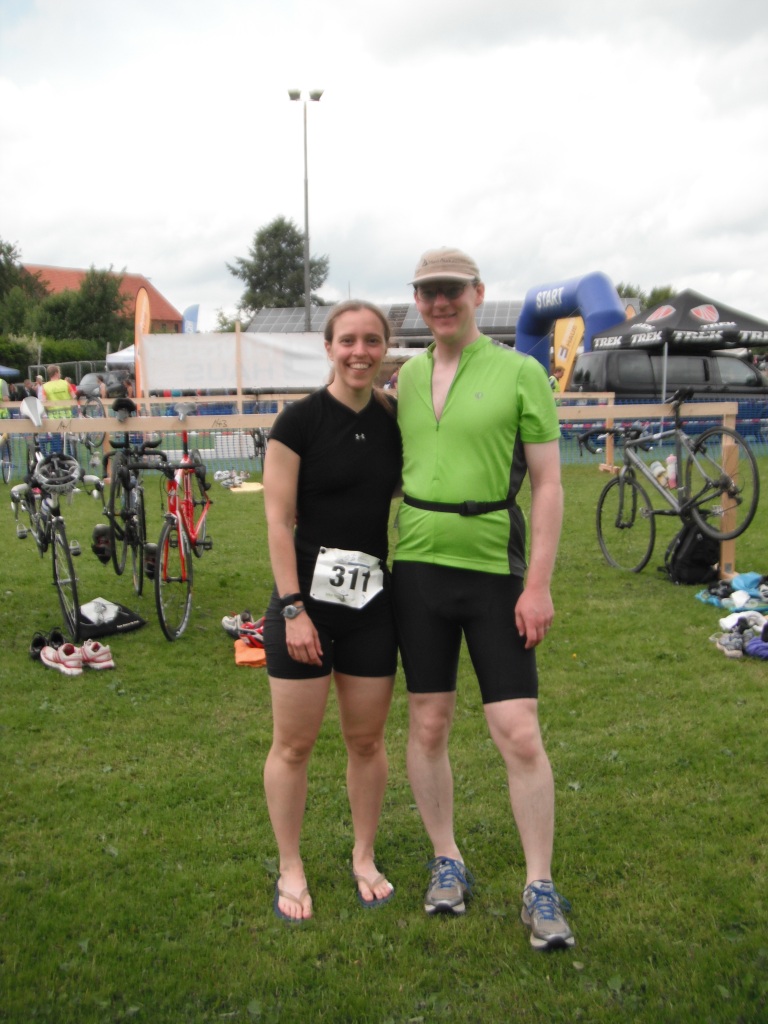
Okay, so, last Thursday, I'm sitting at my computer working.  My wife comes up to me and says "I want to do a sprint triathlon this Saturday.  For exact reasons unknown to me, I said "Sure, I'll do it with you".  Anna was both surprised and excited, so I knew at that point, there was no backing out.  Well, almost no backing out.  We discovered that the water was going to be around 17.7 C, and we didn't actually know how cold that was (64 F) in terms of comfort level.  Some preliminary googling suggested a wetsuit might be in order, however, after consulting with friends on Facebook, it was determined that a wetsuit was not absolutely necessary (which was good, since getting a wetsuit at the last minute was going to be inconvenient).  So, with no more excuses, we got ready for the sprint triathlon.

What I hadn't realized, was that I was also committing myself to getting TO the triathlon.  We don't have a car.  Well, actually we do, but it's in Minnesota, so it does not do us much good for getting to things here in Germany.  So we took a train part way, and then rode the remaining 10km to the triathlon start.  From there it was just a matter of signing in, and trying to decipher where to go, and what the rules actually were (I'd never actually done one of these before, and it turns out there are all kinds of little details, like what do you actually want to wear for each bit?  Where do you put your stuff?  Do you wear the little chip thingy on your ankle or on your wrist?)
Me running so fast the photo is blurry


It was fun.  I definitely could have done better on the swimming - I managed to get behind some rather slow people, and was a little slow in figuring out the best way to pass them.  In the bike ride, I actually managed to pass someone (okay, so I'm not the fastest out there.  In fact, I got beaten by a 75+ year old.  By 8 minutes).
Someone much fitter than me in the process of leaving me behind
I was consoling myself that when one is in last place (or almost last place), at least there's no one left to pass you.  And then the second wave started passing me.  Near the front of these was my wonderful wife, who said hi as she left me in her dust.

Triathlons in Germany seem to have some distinctive features.  One of these is that you might find beer in the water bottle holders of very expensive bikes post-race (or maybe it was there during the race...)


This was also the first race in which my wife won a sausage.  Literally.
Anna pondering what do do with the sausage
The winners with their sausages


Only the best get the wurst
So, that was my first triathlon experience.  It was a lot of fun, and I think I'll probably do another one sometime.  Actually, given that Anna has already pulled up the schedule of when every other triathlon in the state of Hessen is (our state), I give it really high odds that I will be doing another one in the not too distant future.


Actually, there's one more part of the triathlon experience.  And that is that we didn't want to take the train home...  So we biked the 30 km back to Marburg, with all our stuff on our backs.  Which meant we covered a greater distance getting to and from the triathlon (40 km) than we did actually racing it (25.5 km).
 
On the bike ride home.  Note the Pringles can in my right backpack pocket.  If your vehicle is a car, it might not be a bad idea, but when everything you bring is riding home with you on a bike, packing light takes on a new, and previously under-appreciated-by-me level of importance.  The full-sized beach towel will also stay at home next time...


Editor's note (aka Anna): what Sasha is modestly failing to point out is that this is his first race since approximately middle school and a year ago he couldn't run 5km without walking, so I am VERY impressed that he did the running AND swimming and biking and riding home!!  Yay Sasha!!!  And in case that wasn't enough exclamation points, !!!!!!!!!!!

Monday, June 10, 2013

Spanish food is delicious


OK, so I promised my family that I’d write about the food in Spain, and here it is. I’m not going to give you a report of everything we ate in Spain, just some of the highlights.

Probably the most ubiquitous things we ate in Spain were green olives (usually marinated with garlic and/or seasonings and on the table before any other food at every restaurant we ate at) and tortilla.  I don’t mean the flat disks of corn or wheat dough that anyone who has eaten Mexican food is probably thinking of, but instead, what is usually translated on the English versions of the menus as “Spanish omelette”.  They are both simple and delicious, and consist of some sort of fried potato with onion that is then mixed with whipped egg and cooked until it is golden-brown on both sides and solid-ish all the way through. Since I have recently had a tortilla making lesson from Nuria, perhaps I will give you a step-by-step tortilla lesson later on, but for now, you can just take my word for it that tortilla sounds simple from its ingredient list (eggs, potato, onion, olive oil, salt and pepper…that’s it) but is very satisfying to eat.  It is also a staple on tapas menus and we ate them many times during our travels.
Tapas in Madrid, the plate that's mostly empty had held the tortilla, the other things are albondigas (meatballs, left) croquettas (filled with meat and bechamel, middle) and bread (far right) and peach juice. Yum.

I was kind of expecting to eat Tapas most evenings for dinner because they are served earlier and are often cheaper than full-meals, but the problem is that most tapas places at least in the big cities seem to be small hole-in-the-wall places, and it’s just too hard to figure out which ones are “amazing find” holes in the wall, and which are “disappointing and/or sketchy” places, so we mostly were boring and ate at places in our guidebook.  Also, I realized that in a new town, particularly if I can’t read enough of the menu, I tend to pick places by a combination of the number of people eating there and by the look of the food that those people are eating.  That’s an OK strategy (yes, I realize that in tourist towns, the fact that many people use that strategy could lead to weird positive feedback loops on any given night but so be it) but had a problem this trip because most restaurants were empty when we wanted to eat. Yes, the Spanish meal hour could have played a role, but my hypothesis is that given the economic crisis, many people just aren’t eating out very often in Spain.  There’s what, 20% unemployment, and then even many employed people are just not getting paid for their work some months.  I wouldn’t go out to eat often if that were the case for me.

But, back to the food.  We had a delicious dinner in Merida, but the first amusing food story is from the night we were staying in El Rocio.  I voted to go to the Atlantic for dinner, and I wanted fish, so after watching the sun set over the ocean, we found a place that said it did fried fish (not in our book) and then promptly had a problem. I don’t know Spanish, and while Sasha can say many things (including basically everything you need to get hotel rooms, rental cars, etc.) he doesn’t know the Spanish name for most species of fish.  So we ordered non-fried shrimp (no problem, even I knew the word for shrimp) then wanted some fried fish and asked the waitress for a recommendation, and she recommended something that started with a B.  She said they were delicious, so we were excited, but then we got a pile of lightly breaded and fried fish that were maybe two inches long and were gutted but still had heads, tails and skin on…Hmmm… we had to ask how we were supposed to eat them, and (we think) we were told to leave the heads and tails and just eat the skin and meat off the backbone.  Maybe you could eat the whole things, but the tails and spines seemed a bit poke-y and the heads just didn't seem appealing.  They were good, if a bit of work.
How often does dinner require instructions from the waitress?

The fish. Still don't know what they were. Not that I've tried to figure it out.

The shrimp and the olives. We knew how to eat these.
The next night, we ate right at our hotel and the food was fine and the Sangria was also fine.  Mmmm....sangria...

Then came the best meal of the trip.  We ate lunch with Nuria and her family, and I think they were excited to have foreign guests, so served us a whole slew of amazing things.  First, we had slices of jamon (spanish for ham, but it is a different thing from your average US grocery store ham; closer to prosciutto) and sausage and tuna mixed with roasted, olive-oil soaked peppers, and bread and delicious tomatoes.  We could really have stopped there and been satisfied, but then, there was stew called puchero (I think it can also be called cocido) that contained several different types of meat and chickpeas and carrots and potatoes and we first ate a bowl of the soup part. It had the color of chicken noodle soup, maybe a bit more golden, but it had such a complex flavor it was amazing (apparently you need to use 2 very specific types of salt-cured bones to get it to taste right), and the whole thing was cooked in a pressure cooker, so the chick peas were silken almost, which was also delicious.  Then, we took bits of the meat that had been cooking in the soup and mixed in a small amount of pork fat that had been cooking with it (we used just a bit of the fat, but were told that it needed it to be authentic) and the meat was so tender and the fat infused it with richness, etc. that it was also amazing.  OK, that would have also been enough, but THEN Nuria’s sister had made a soup called Salmorejo that is usually tomatoes and garlic and bread that’s then blended to be smooth (like gazpacho but not quite the same) but apparently her sister roasts the garlic and tomatoes first, so the soup was still a creamy smooth pink, but the flavor was, well, more nuanced and rounder like you’d expect from roasted ingredients. Wow.  I love food, and that was an amazing, amazing meal. Yum.  Nuria half-jokes that maybe if she can’t figure out what to do after this post-doc in science, she should open up a restaurant.  I think she’s also a good scientist, but if she goes the restaurant route, I’ll try to be the first in line when it opens!

That evening, we went out to a delicious tapas place.  We had a bunch of things since there were 4 of us, and they were all great, from favas with ham, to these delicious guys:
I think they were cuttlefish, but I know they were delicious, as does Marek (posing in the picture)

The last thing I want to particularly talk about are churros. I remember having churros at the roller rink where we had skating parties in elementary school, and I remember ridged things fried and dipped in cinnamon and sugar.  Maybe those are more like the Mexican verison, but the Spanish ones that we ate were smooth on the outside and are extruded by a fancy machine right into hot oil in long ropes, which are then cut and served to you while still quite hot.  We had them in Tarifa and got them to go, so just emptied a few packs of sugar into the paper bag and shook it to coat them with sugar (and ate them sitting on a stone wall watching a kite surfer playing) 
OK, so we started sampling them before reaching the beach

but then we had them in Madrid in true Madrid fashion, with a cup of hot chocolate (not hot chocolate like you drink, but something that is much thicker, think melted chocolate bar) to dip them in before every bite.  Yum. AND, they had this nifty orange juice machine where they could push a button and the oranges would get automatically cut in half and squeezed.  That was some of the best orange juice, and was the perfect beverage to counteract the intensity of the chocolate and the grease of the churros; I had 2 glasses.  If you are going to Madrid, make sure you have such a meal.  We ate at Chocolateria Valor because our book said it was the best in town, but if you find a better one, please let us know and we’ll have an excuse to go back to Spain.    
Best. Breakfast. Ever. (or at least one of them)